The Plan · Homes
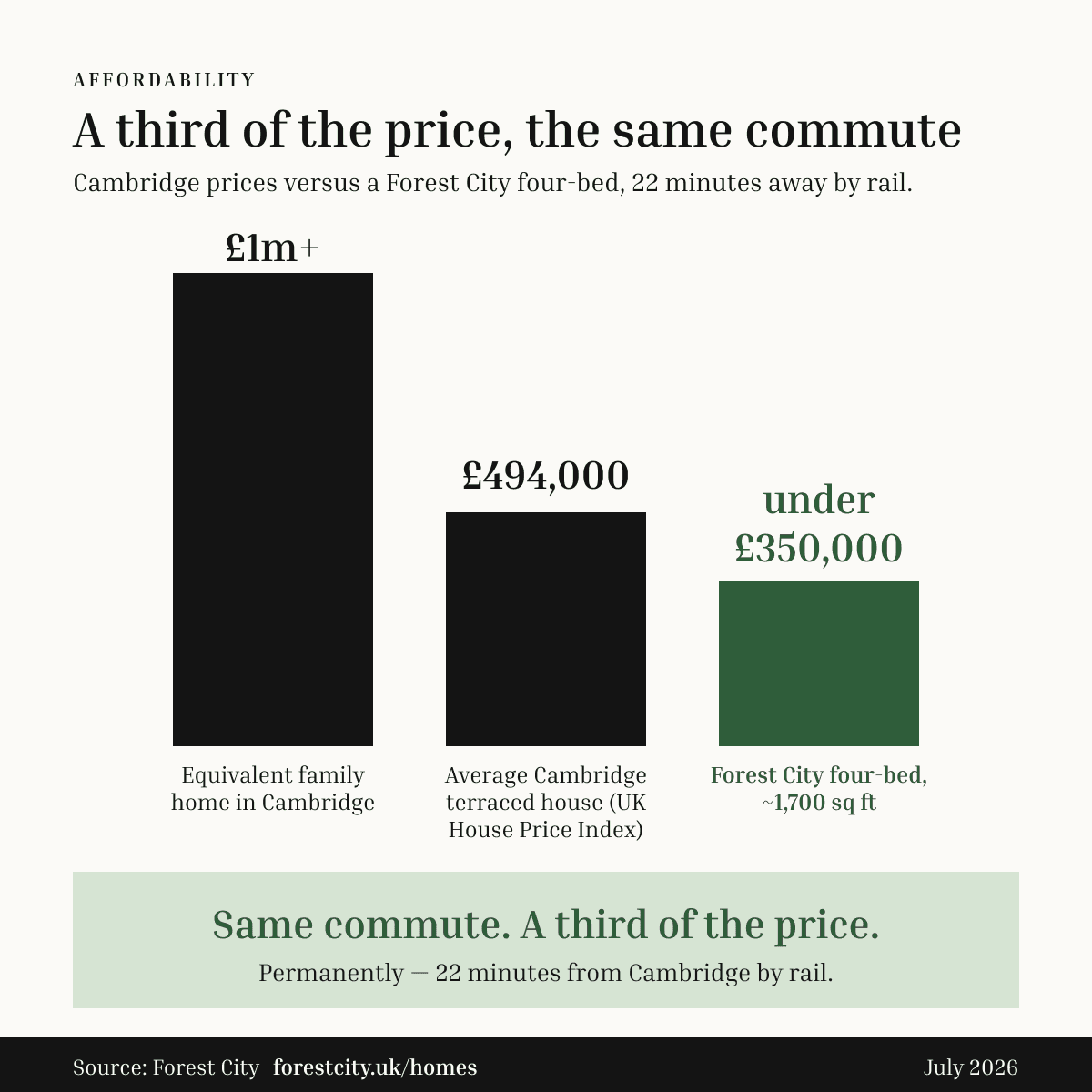
A four bed family home. Designed to sell at £350,000.
The same house in Cambridge costs over £1 million. Twenty two minutes away, we're designing one for a third of the price. Permanently affordable, and yours.
The home
A four bed terraced house of 1,700 square feet with room to raise a family and a short walk from a tram stop, and the forest. Built with a timber frame, and faced in stone, and likely to generate enough electricity to power itself, every home is made with dignity in mind.
This isn't the only housing type Forest City will offer. There will be apartments, mansion blocks, and two and three bed homes to buy and rent. But if we can do it with a 4-bed, we will feel confident that every home can be both beautiful and affordable for all.
Initial floorplans and renders for the 4-bed home are coming soon. Sign up and you'll see them first.
How it stays affordable
When you take for-profit developers out of the loop, and do things at scale on land that is 99% cheaper than land in the centre of Cambridge or London, you can make homes very affordable. In order to keep it that way, and stop people flipping homes that will be worth 80% more on the open market, we're establishing a Community Land Trust.
You own your home outright. But if you buy it at a discount, you must also pass the discount on by selling it back to the Trust. The longer you live there, the more equity you can release for yourself. A Community Land Trust means you're far more likely not just to get on the housing ladder, but also walk away with extra capital should you decide to move out. Around 70% of homes will be sold this way. A further 30% will be available to rent through a cooperative, ensuring affordability whatever your needs.
How we get the price down
Our Housing Expert Working Group tested the £350,000 target against real construction costs, real suppliers, and real market conditions. Their conclusion: it can't be done the way Britain currently builds. But it can be done if we build differently.
In our case, that means robot built timber homes at serious scale. Standardised designs, refined and repeated. Terraced and mansion block typologies are also not just very cost efficient — they are great at forming well-knitted communities. Finally, our delivery model is organised around production, not margins.
These are exactly the kinds of problems you can only solve at the scale of a city. No housing estate of 500 homes can succeed this way. A city of 400,000 homes can.
A real city around it
Homes at density comparable to central London's, but planned properly: schools, health centres, parks and transport designed in from day one, not squeezed in as afterthoughts. And a 12,000 acre nature reserve on your doorstep.
Be first to see the £350k home.
Floorplans and renders are coming soon. Get them in your inbox.
Follow Britain’s next great city
Get progress updates straight to your inbox