We throw around terms like "NIMBY," "YIMBY," and "Vegetable Lobby" with casual abandon. But are we using them correctly? More importantly, are we missing the nuance that might actually help us build the homes Britain desperately needs?
Having spent the last 4 months campaigning for a city to be built in Britain, I've encountered every flavour of objection imaginable. What I've learned is that lumping all opposition together under the "NIMBY" label is counterproductive.
Here are four distinct archetypes, and why understanding them matters.
The Utilitarian Environmentalist
In the past year and a half, Paul Powlesland and I have sparred on Twitter on many occasions. I think he saw me as thinking "build at all costs, nature be damned." I saw him as thinking "nature matters more than humans."
Reader, we were both wrong.
Working together on Forest City revealed that we share more common ground than either of us expected. It turns out Paul believes nature is valuable - but also that humans exist and occasionally need somewhere to live. I believe houses, industry, and commerce are necessary - but also that covering England in concrete would be bad. We both believe nature has intrinsic value. We both believe development should account for environmental impact. We both believe living near nature improves quality of life.
Paul now advises on Forest City's 12,000-acre nature reserve. He understands that building a city requires, well, building. He also understands that doing it properly could create more nature than a thousand planning refusals.
Utilitarian environmentalists like Paul represent Britain's best hope for reconciling our housing crisis with our nature depletion crisis. They engage in good faith, weigh trade-offs honestly, and push for better outcomes rather than no outcomes. Paul Powlesland should write a book.
The Professional Objector
Rosie Pearson has been termed by The Times as "Queen of the NIMBYs," which is rather like calling a great white shark "King of the Goldfish."
A NIMBY objects to building near their back yard. Pearson objects to building near anyone's back yard. And their front yard. And that empty field three counties over. Her opposition isn't geographical; it's existential.
Her campaigns have targeted projects across the country, employing whatever argument seems most likely to succeed - environmental damage, traffic concerns, food security, heritage impacts - but the destination is always the same: nothing should be built, anywhere, ever, and she'll find a reason why. Strip away the tactical framing, and what remains is opposition to change itself.
Here is an exchange she had with Shiv, my co-founder, where she stated, quite openly, that even if all of her "concerns" were addressed, she wouldn't change her mind. Which at least saves everyone time.
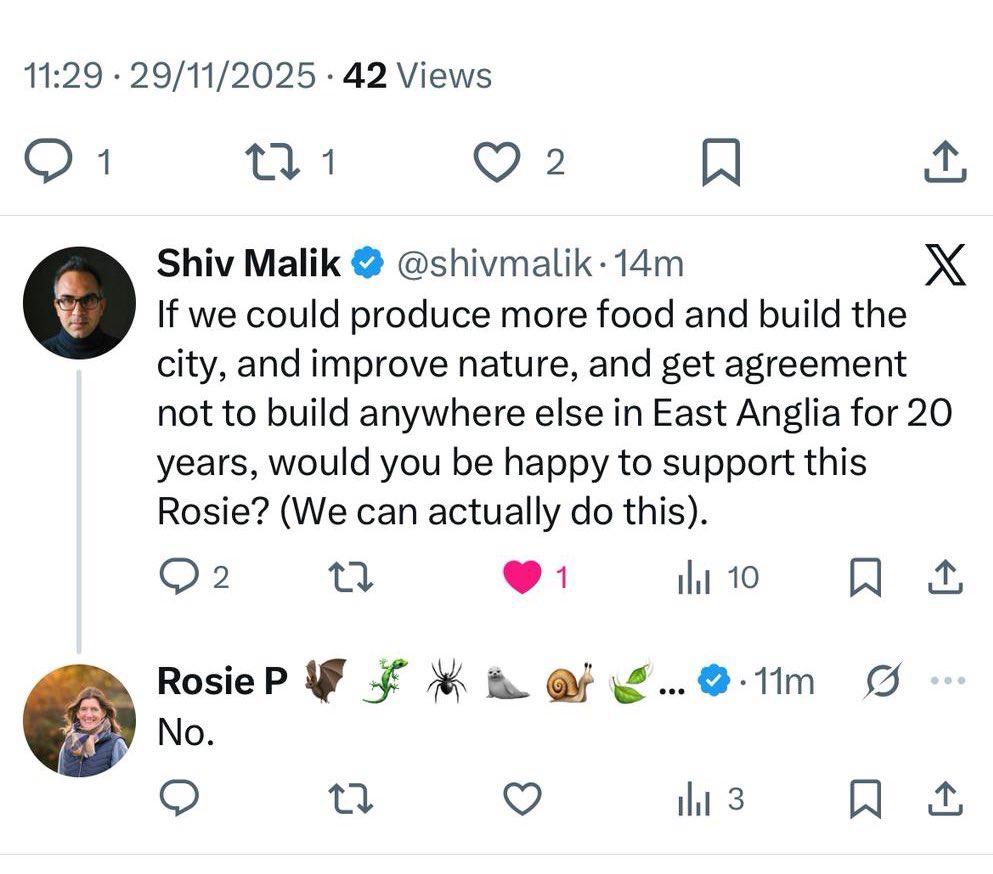
These objectors serve a useful function, in the same way that a smoke alarm serves a useful function: alerting us that something is happening. The difference is that smoke alarms stop when you remove the danger. Professional objectors have no off switch - they give environmental campaigners a bad name.
They are, for practical purposes, purely negative forces - on Britain's economy, on people seeking homes, on nature, and on everyone's time.
The correct response to them is no response.
The Anti-Immigration Campaigner
Groups like Build for Britain present a different challenge. They use housing scarcity as a Trojan horse for immigration restrictionism.
Their argument: building more homes merely creates capacity for more immigrants. Therefore, don't build homes until we've kicked out existing immigrants.
Set aside, for a moment, whether you think Britain should have more or fewer immigrants.
Our economy currently depends heavily on immigrant labour. Remove that workforce overnight, and who replaces them? There is no reserve army of British-born bricklayers, cleaners, and other blue-collar workers waiting in the wings.
We need to solve the issues stopping British people from having children - lack of housing chief among them. Groups like Build for Britain oppose housing developments, despite it being the only way to achieve their goal of reduced immigration in the long term.
We haven't built a reservoir since the 1990s. We have the oldest housing stock in Europe. These are not problems caused by people arriving from abroad. They are problems caused by people who were here all along, saying no.
The Concerned Local
Finally, we arrive at the actual NIMBY - the person who lives somewhere and doesn't want awful houses built next door.
Their objections typically run as follows:
- "The houses are ugly." (They are.)
- "The roads can't cope." (They can't.)
- "It'll be a soulless commuter estate." (It will.)
- "The 'affordable' homes cost £900,000." (They do.)
These objections are not irrational. They are accurate observations about British housebuilding, which has spent fifty years optimising for "maximum profit per acre" and "aesthetic qualities of a cardboard box."
The concerned local isn't the enemy of housing. They're the victim of bad housing - and they'd rather have no housing than more of the same.
The answer, counterintuitively, is to build bigger. City-scale development allows infrastructure before houses, real placemaking, design codes with good standards, and generates commercial land that can subsidise genuinely affordable homes.
Scale, paradoxically, is the answer to locals' concerns.
In Conclusion
Not all opponents of development are NIMBYs. Some are potential partners. Some are professional obstacles. Some are using housing as cover for entirely different concerns. And some have complaints so legitimate that the only honest response is "yes, you're right, and we should do better."
Understanding the difference won't make planning applications fun. But it might make them possible.
Follow the Forest City project at ForestCity.uk