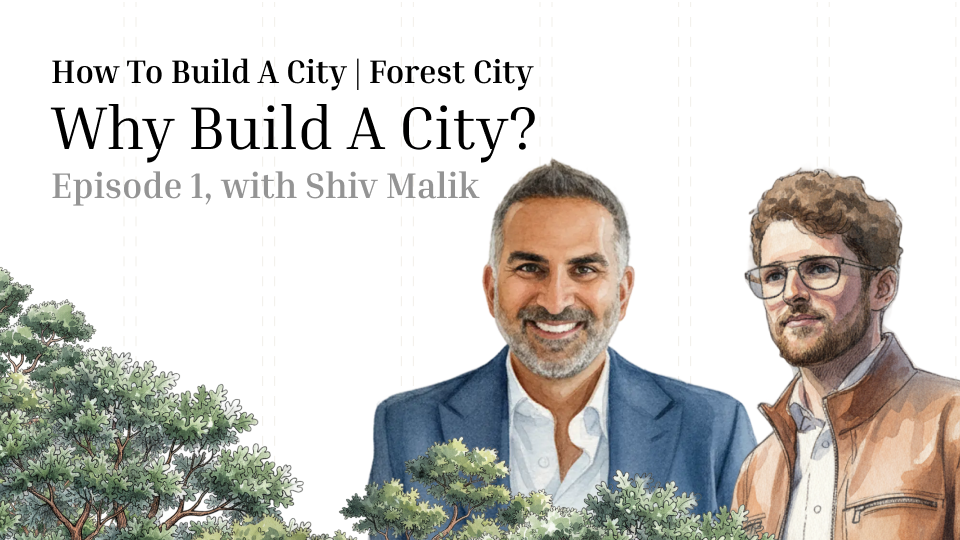
How To Build A City, Episode 1: Why Build a City
Co-founder of Forest City and co-founder of Looking For Growth.
Co-founder of Forest City and former investigative journalist at The Guardian.
We’ve started a podcast. How To Build A City is a series of conversations with the people behind Forest City — water, transport, nature, and the rest of the work of actually building a city. Episode 1 is out now on Spotify, Apple Podcasts, YouTube, and all major platforms.
Forest City is a proposal for a new city of nearly a million people on 45,000 acres eight miles east of Cambridge, between Haverhill and Newmarket. In this first episode, Joe is joined by his co-founder Shiv Malik to explain why Cambridge — a city of just 50,000 homes that has produced more Nobel Prizes than the whole of France — can’t simply grow outwards, and why building alongside it is the only way to get the reservoirs, hospitals and rail capacity the region already needs.
They also cover how they met (at a pub, on Shiv’s birthday, with 200 people spilling onto the street), the night they announced the project to 1,200 people at the O2, and the 100-odd contributors who wrote the feasibility study for free.
Plus: the 366,000 homes East Anglia has to build over the next 30 years whether Forest City happens or not — and what those homes look like if nobody plans for them.
Listen
If you want to be first in line for a home, sign up at forestcity.uk to join the waitlist. More from Joe and Shiv on our people page.
Transcript
Joe Reeve
Welcome to the first episode of the Forest City podcast. I think for now I'm going to call it "The How to Build a City" podcast, but we might have to change that. I'm not sure. In this podcast, each episode, I'm going to go deep with a different member of the Forest City contributing team. We're going to focus on different topics, things like water or transport or nature. In this first episode, I'm joined by my co-founder of Forest City, Shiv Malik. We talk a little bit about how we met, about our motivations, why we're doing this. We talk a little bit about how it fits into politics more broadly and some of Andy Burnham's more recent political agenda. This is an experiment for us. We're still learning, so we'd love any feedback you can share. I think the conversation is just really fun. Shiv and I don't get a lot of time to sit down and chat with each other. We're always doing things and, yes, talking, but not necessarily having a nice, relaxed conversation. Usually, it's responding to something or pushing for something. So this is a really nice opportunity for us to chat, and I hope you enjoy listening in as well. So we actually met on your birthday, didn't we, Shiv?
Shiv Malik
Yeah. Somewhat embarrassingly, I decided that for my, was it 44th birthday? I would spend it hanging out at the pub, which is the right thing. But it was at an event for infrastructure, ostensibly with Looking for Growth. And there were 200 people spilling out of this pub. It was astounding. I'd never seen anything like it. I'd been waiting for 15 years for young people to get organized about the problems that Britain was facing. Foremost among them is housing and infrastructure, right? And I saw you on a stage, and I was like, "That's the guy." And you said something that really, really stuck with me. You said, "The cavalry isn't coming. We are the cavalry." I thought, "God damn it." And literally in that moment, I thought, "Right. That's it. I'm going to build this city. I'm going to tell Joe about this, and I'm going to try and win him over."
Joe Reeve
Yeah. I had a lot of great conversations that evening. I remember chatting to you about your book, and then you told me it was your birthday, and I was like, "What is this guy doing here? Why are you here?" Like-
Shiv Malik
What a loser. Yeah. Well, then the worst part was that you got everyone to sing me happy birthday.
Joe Reeve
I was going to say that was the best part.
Shiv Malik
Oh, when you're 44, it's pretty embarrassing. But also, I've never had 200 people sing me happy birthday before, so it was kind of nice. So thanks. Yeah.
Joe Reeve
Yeah. I think that actually is one of those things where when you're trying to get a community of people, particularly about something that's kind of boring, like policy. Sorry, excuse me for saying that. Policy is not famously exciting, but I think the fact that there is this community of people that really actually care about one another and also obviously care about the country and care about fixing, improving the policies. Having something like that, I think a lot of people actually left thinking, "Wow, this is the kind of place I can come and like people will sing each other happy birthday." I think this may be easy to overrate. I don't know. Or underrate, I mean.
Shiv Malik
No. Well, here's also the interesting thing was that, look, from that moment for the next six months, obviously, I think you describe it as me kind of ringing you up almost every two days or whatever to talk about this, to kind of pester you. But it allowed me to also have a foil to test my arguments, because I'd never really spoken about these ideas publicly. I'd done it once before, like four years before. But it was a really intense period where I was trying to write this formative document, which is called "Let's Build a City." That's what we called it at the end when we launched it. And it was all leading up to then what would be you again on a stage, but announcing Forest City, so October the 23rd, at one of the stages at the O2 Centre in front of 1,200 people. And that was an amazing night, right?
Joe Reeve
It was an amazing night. I did feel like a complete lemon on stage talking- ... saying, "We're going to build a city." And then everybody was like, "What did Joe just say?"
Shiv Malik
Yeah, but minutes later, literally minutes, it felt like it was a couple of hours, we put the tweet out, and we got... Between our two tweets, I think we got easily a million people viewing it, liking it, retweeting it. So it was an amazing response.
Joe Reeve
Yeah. It was. I wasn't really sure what to expect from announcing it because it is this bold, crazy idea that I think most people when they look at it, and in fact, even our strong detractors tend to say, "This makes sense. I understand why you're doing it. I understand the problems. The solution maybe even makes sense. But it's just too hard," or, "It's not something that 21st century Britain can do," or something like that. But people understand where it's coming from and how it's going to solve the problems. I think that's one of the things that you need a few crazy people who will ring people up every other day and say, "Hey, please..." Oh, not please, but, "Hey, here's the update. Here's the update. Here's the update." Or go on a stage and say something that maybe makes them look a little bit silly in the moment. But actually, it feels like the people just keep surprisingly saying yes. All the people we need to talk to, they pick up the phone. Because it's actually, there aren't that many people who, in all seriousness, are trying to build a city to solve a problem. Actually, that's kind of what I thought you were initially when we first started talking. I was like, "Oh, yeah, another one of these libertarian crypto guys wanting to build a new city." But that actually obviously isn't quite the case.
Shiv Malik
No, and look, there's plenty of kooky people out there who just like, "Oh, I've got this amazing idea for a city because..." And then they're interested in some bit of tech or the crypto world and decentralization, or charter cities, for example, breaking free of the nation state.
Joe Reeve
A floating city or-
Shiv Malik
Yeah. Right. There's always some kind of little twist, or it's like a space city, so it's got to have a space port because that's the future. You're like, "No, hang on," right? What are we actually trying to do? We're actually trying to solve a problem, and it turns out that building a city is the way to do that. So it's like with regret, we have to build a city. But what is the problem at the heart of it? And the answer is, it's really clear. It's a social contract. Right. So what does that mean? It means can you work hard, buy a home, and raise a family? That's the bit of the social contract that we care about. And of course, there's the other bits of the social contract. Well, if you do work hard, you get a pension, and obviously lots of pensioners who are boomers are going, "Great, that's my bit of the social contract." Well, our bit isn't fulfilled right at the moment, and it's been left unfulfilled for 15 years plus. Mm. So fixing that, turns out one of the great ways to do that is by building homes and housing at scale, which is called conventionally a city, right? So, it's sort of therefore with regret we're building this city. But it is the way forward. And of course, once you unlock that, then you realize actually there are lots of people with huge experience, wonderful ideas, who want to take this forward and help you to do that.
Joe Reeve
Yeah. I think another nice thing about this is obviously as a city, it's a bit of an attention grabber, right? If we were saying we're building a new town, trying to ring people up and saying, "Hello, we're looking for a really good architect to design our new town." They'd be like, "Yeah, join the queue. There are a hundred of you." Or the government's trying to do it.
Shiv Malik
Or please give us 20,000 pounds as a deposit, right? Because we also did this with no money.
Joe Reeve
Yeah.
Shiv Malik
We're still doing it with no money.
Joe Reeve
Yeah. Still. But instead we were like, "Hey, we're building a city. Here's an article in 'The Telegraph.' Here's an article in 'The Times.' Here's an article in the 'FT.' Here's an article in 'The Guardian.' Do you want to chat?" And pretty much everybody picks up the phone. But even some of the best people in the world at designing cities and master planning and just building stuff and making it happen.
Shiv Malik
Yeah. No, that's true. It's an amazing door opener, and actually it's got even better as we've kind of survived and then thrived a bit, with all the media. And people expected us to fail, I guess, in the first month, and we're still here eight, nine months later. Yeah. It's a testament, and people then... In fact, people went from, "Oh, those crazy people, we don't want to speak to them," to, "Why haven't they rung us?" Right? Like "How rude."
Joe Reeve
Yeah. We had a really angry former MP, right, come to one of our events and saying, "You should've invited me. You should've asked."
Shiv Malik
Yeah, exactly. Yeah. So, that's nice when that script flips. But look, I have to say as well, I certainly couldn't have done it without someone to be a foil with, to be a partner with. And we spent, basically work husbands, right, at this point. Much to the chagrin of our wives. Actual wives.
Joe Reeve
Yeah. Daria does call you my second wife, so.
Shiv Malik
Yeah. So there we go. But it requires two people at least, right? Be on a level and be able to just go through all of this stuff day by day, hour by hour, minute by minute. And to know that I'll ring you at 11:30 at night or whatever, and you'll pick up, and we're on the same page always.
Joe Reeve
Mm.
Shiv Malik
So, it does take two.
Joe Reeve
Yeah. And I think actually one of the maybe less appreciated things as well is the emotional toll. I don't know about how well I deal with it, but it is because there are some people who really don't want anything to change. It's not even just people in a specific area and not just locals. It's people around the country. It's people that I think both of us expected would be supportive of it. Yeah. And then they turn around and just sort of behind our backs are talking against it. So that's actually been something that has been surprisingly emotionally difficult for me, draining on my energy, my optimism, my ambition. I guess similar for you. Afghanistan, so.
Shiv Malik
Yeah, somewhat. You've had guns held to your head in- Right So, I had a history of going off and doing war reporting and the like, and yeah, I've had guns held to my head on three occasions and had to wheedle out, talking to try and get information out from people like Al-Qaeda or far right or secret sources here. And I've had the police put me through court to try and get my sources. And so I've been through a lot on that front. And lots of ups and downs. And that prepares you for hard challenges, right? And that's not to say that you haven't had those things. You've absolutely had those things in your life, too.
Joe Reeve
I've never had a gun held to my head in all seriousness.
Shiv Malik
Okay. Well, you know.
Joe Reeve
We'll see. We're going paintballing on Saturday, aren't we? So.
Shiv Malik
Yeah. That's right. So, I think that's going to be held to my head. But look, that's not to say that... Well, both of us have gone through ups and downs and at different points. Thankfully not both of us together at the same time. Again, that helps when you have two of you to kind of level each other out, right? But you're right. I've also been surprised at detractors, vested interests that we've come up against. And if you're an optimistic person, maybe you also have to be slightly naive, right? Mm-hmm. But that isn't good when it comes to dealing with things like vested interests. But at the same time, we've been equally, I guess, surprised by the people who have come out suddenly of the woodwork and gone, "Yeah. You know what?" And we thought we'd never win them over, and they've gone, "Actually, that makes not just a lot of sense, but this is something that we're kind of willing to risk some political and social capital on." And so, it's been an amazing journey, right? Yeah. It's a rollercoaster- Yeah ... so far.
Joe Reeve
Yeah. It's wild.
Shiv Malik
Yeah.
Joe Reeve
I can't wait for the rest of it.
Shiv Malik
We're still in the planning phase. Yeah. We're still in the planning.
Joe Reeve
Right. Still in the planning. Yeah. Obviously, we've got this sort of planning phase, which we actually really only just kicked off the full master planning phase. And so we've got planning for a year and a half, two years, and then there's a bit more politics, and then it's the building phase. And so obviously in the building phase, that's technically owned by the government as a development corporation. That's not us doing the building per se, although there's other sort of stuff we're going to have to still be... It's not like we're done and we can leave. There's a lot of the sort of making sure the funding's lined up and keeping the thing on the rails. So, what do you think about sort of how- ... how we're going to feel as we go through that process. Because I guess it's going to-- So far, it feels like every conversation that we have could be, it's either we can continue or it could just kill the project.
Shiv Malik
Yeah. And I think, look, other developers, if you want, and neither of us are developers, so we don't know this intuitively, have to face this constant existential set of threats. And because it's so big and it's contentious because of its size, those threats are more existential than I guess other people have to face. But here's the bit that I'm relishing at least, is just there's a morass of detail. There's so much detail in master planning, just anything, let alone a city. Any kind of large-scale infrastructure project like this. And it also means that it's a huge moment to just learn about everything from the tiniest kind of detailing and robot carving that could be done on lintels for the house that we're building and some lintels on some of the houses. All the way to, okay, well, how do you get an NSIP for a reservoir? And what about the 1975 Reservoirs Act? And what are the implications to... And the list just goes on and on and on.
Joe Reeve
Mm-hmm.
Shiv Malik
And then obviously, there's all the human skills that have to kick in. And I'm constantly, like you, on the phone to people, from councillors on a town council to people in the civil service to, that just reminded me I need to respond to an email. And we're late to do so. So, there's a lot, and it's going to take a lot, but so far, we've been amazing partners in that. And actually, let me say one other thing, which is the people that we've managed to bring in to work on this project, at first, completely pro bono. And that was, I think, one of the most humbling things that happened.
Joe Reeve
Yeah. It's like 40, 50 contributors to the main report, and that's just the people that contributed to the report. There are other people as well that have contributed in other places.
Shiv Malik
Yeah. It's at least 100 people all in all. And they really have contributed in a way that you just think, oh, well, I had this inkling only because it was sort of written about. You ask people for big things, and they'll actually deliver far more than they would if you ask them for small things. Because then people are like, "Oh, it's whatever. I'm not bothered about this tiny little thing." But you ask them, "Can you write a 100-page report on transport?" And they go, "Yeah. I'll do it because I want a city to be built." That's amazing. That never happens. So that's been incredibly humbling. And then obviously, we've now started to professionalize, and those people have been, now we're saying, "Okay, well look, maybe we can bring you on more full time." And the skills and the quality of people, again, are outstanding. Absolutely outstanding. Some of the best people in Britain. And Britain's actually one of the best places in the world to do what we're doing.
Joe Reeve
Yeah. Well, because Britain designed Dubai, basically, right?
Shiv Malik
Yeah. All our best people have gone around the world to build cities, in many cases. And just not at home.
Joe Reeve
Yeah.
Shiv Malik
So they're all really also kind of, there's a huge amount of talent to draw upon.
Joe Reeve
Yeah. Time to come home and build the future of Britain.
Shiv Malik
Exactly.
Joe Reeve
Yeah.
Shiv Malik
Exactly.
Joe Reeve
I'm so excited for the future of the project, but also just of Britain. And it really feels like we're about to sort ourselves out as a country. It feels like there's something in the water. I don't know. Certainly with young people, I think there's sort of quite a broad range now of people who are just sort of saying, "Right, it's not getting better unless we do something, so we're going to start doing something."
Shiv Malik
Yeah. To stick to the, maybe hydration theme, we don't want to drink our own Kool-Aid, right? Mm-hmm. But I think you're right. I'll give you a concrete example. Michael Dnes, who's an amazing transport planner, worked at the Department for Transport, incredibly well-respected. He has been giving us advice, but also working on his own project, which he's now made public, to build a tunnel through the Pennines to connect, effectively, Sheffield, and therefore Manchester. And it's the same modeled on us. And actually, he's told us, "You guys were an inspiration for us coming forward." He had already had the idea. But he's like, "Look, we can do this." And again, it's a private campaigning organization to try and get this off the ground. That's amazing, right?
Joe Reeve
Mm-hmm.
Shiv Malik
And again, I think, yes, we've got a change in prime minister. Yes, there's certainly a shift of energy, but it's also because we've been at rock bottom for so long, I think everyone now thinks, "Well, maybe the only way is back up again," right?
Joe Reeve
Mm-hmm. Things can only get better.
Shiv Malik
Yeah.
Joe Reeve
Yeah. I think for me, yeah, goal one is get a city built and sort of have that GDP bump to the country and really start to actually get the direct impact from the city. But goal two is just to prove to people that Britain can do things, whether it's build a city or build a tunnel or just be ambitious in the first place. I think that's sort of a really nice secondary goal that I definitely want to be leaning into as we start getting more and more public progress that we can share. That really just trying to inspire Brits, that young people, old people, anyone in Britain can actually just do stuff to make the country better, and it's okay to think in terms of 100-year, 200-year timelines, just like the Victorians did, and not just in the sort of maybe five-year timelines that we tend to think.
Shiv Malik
Yeah. And I think it's hard to break people out of that mindset that stagnation is all that we get. In fact, we've been at this for so long, 15 years of stagnation in effect, that people don't know what a wage increase is anymore, right? I vaguely remember it because I had a working life that was pre-financial crash. And businesses, it was really normal to have an expense card. Or just go and fly and put that on expenses and do stuff, and it would be fine, and businesses would grow every year, and there'd be a bit more money in the pot for X, Y, and Z, therefore. It hasn't existed for 15 years, and people have had whole almost careers now, living with zero wage increase, in effect. And that's terrible. So yeah, it takes something really quite radical, I think, to shift people out, and they see it and they go, "Hang on." Now, we still have to, in effect, succeed at this, I think, for people to really believe that we, Britain, can do big things again. But again, we did the Olympics not very long ago. That was 2012. In the same era that we also had HS2 commissioned. Now, people remember the HS2, but they don't remember the Olympics quite so readily. And that is partly because basically we're British. We're like, "Oh, yeah." We like to be a bit Eeyore-ish about all of this stuff. But I think you're right. We have turned a corner. It feels like that.
Joe Reeve
Yeah. So 45,000 acres, eight miles east of Cambridge, between Haverhill and Newmarket.
Shiv Malik
Why Cambridge?
Joe Reeve
Arguably, Cambridge is one of the most important cities in the West, for its science output, primarily. It's got Cambridge University, which for Britain is so, so important. But also, the stuff that gets invented in Cambridge ends up running defense in America, it protects us in Europe. It's just really, really important stuff, from quantum computing to food security to defense. So Cambridge is really important. The problem is, it's actually tiny. A lot of people don't realize this, but Cambridge only has 50,000 homes. It's 150,000 people. You might think it's one of the biggest or most important cities the way people talk about it, but it's actually tiny. And people are really struggling because it's so small, but there's so much demand to be there with all the lab space and the university. It takes people so long to get in and out. So you've got some of the smartest people in the West, smartest people in Europe, certainly. Nice point, by the way. The city of Cambridge has produced more Nobel Prizes than all of France put together, which as a Brit, I love. So you've got some of the smartest people in the world, let's be honest, traveling an hour and a half each way to get into work, which is just insane. Imagine if they were spending that three hours instead of driving or on the train, they were spending that doing more research or maybe even just spending more time with their families. Wouldn't that be better for everybody?
Shiv Malik
What's wrong with just expanding Cambridge from its center?
Joe Reeve
Yeah, so expanding Cambridge from its center seems like a good idea at first, but actually part of what makes Cambridge so lovely, it's really old, it's medieval streets, all this ancient, really nice British heritage. It's really hard to expand it radially because we already, with the current number of homes, get water shortages all the time. We've got two hospitals in the area. One of them has been in an emergency state for the last two weeks. There are hosepipe bans all over. There's not enough water, there aren't enough schools, there aren't enough hospitals. And so if you wanted to build it out, you'd have to build all of that stuff first. But, and this is actually one of the reasons that lots of the cities in Britain are really nice. You've got this green belt. So it means actually the land just around the city, you can't build on. So you have to try and pack more and more homes in really tightly. So there's no space to build a reservoir. There's no space to build hospitals or schools. So you can't really expand it radially very easily. But then there's even more of a problem, which is if you want to have more people, you need to give them ways to get in and out. And so that means maybe building a tram or a metro. Metros are really expensive, so it's really hard to build a metro in Cambridge. So you think, okay, a tram may be lighter and easier to build. But what that means is you have to dig up all the nice ancient cobblestone streets in Cambridge, the medieval streets, and replace them with a tram. And I think that's going to be not only really hard practically, but also, to be honest, it'll be a bit of a shame to damage this historic medieval city. So that's one of the reasons that we've proposed doing it, not expanding the city radially, but just moving a little bit to the side so you can get in and out easily. You don't need to do too much transport infrastructure, but if you do it just to the east of Cambridge, there's enough space that you can build hospitals. You can build four hospitals, in fact. You can build a reservoir. You can build all that transport infrastructure that you need upfront without having the problems that you might have expanding Cambridge. So what if Forest City doesn't get built? What happens in East Anglia anyway?
Shiv Malik
Well, fascinatingly, if you take a 30-mile radius from Forest City, and you tot up, well, what are the number of houses that need to be built this year, and project that forward 30 years. What is that number? And the answer is actually 366,000 homes. So in the whole area, 366,000 homes need to be built anyway, which is actually around a population of a million. So we're not actually proposing anything different from the current measures on what's required over a 30-year period. And then you have to ask, well, the question now isn't whether these homes are going to be built. They are. How are they going to be built is the outstanding point. And so, yes, you've got Forest City on one end with not just the homes, but all the infrastructure, all the added benefits for the economy. 53 billion in GVA is not a small number. Because you put all the things in one place. That's how agglomeration works. That's why cities are successful, because they're all close together. Or the alternative is the status quo. What's that status quo? Well, everyone kind of knows it, right? If you live in a mid-sized town or a village, you've seen development, right? What does it look like? Well, it looks like that. So that you just get more of that, which means no infrastructure. The developments are smeared or peppered everywhere. They look pretty ugly. They're pretty unaffordable. The only people really kind of making money out of it are the landowners on the edges of villages, who can sell a couple of acres here and there, and maybe some developers. But they're not doing so well either, because the houses are too damn expensive for anyone to buy. So that's really the ... It's not whether we need to build these many homes or not, it's how do you want them to be built?
Joe Reeve
Mm. It's kind of crazy, because we're saying we need to build 360,000 homes there regardless, but there's no plan to build a reservoir there from the government or anything. So the government's saying, "You're going to have to build these homes." They're going to be, like you say, smeared everywhere. They're all going to be ugly. They're all going to be expensive. And also, they're not going to have the reservoirs, even though there are already water shortages in the area.
Shiv Malik
Right. And it's not obviously just water, right? So it's transport. How do you deal with extra road capacity if you're going to build basically more suburban sprawl? I guess sewage. Right. What about dentists? What about GPs? What about schools? What about libraries? What about civic institutions? What about the police? I mean, that list goes on and on and on. And again, you can't really deal with it if you've only, "Well, we've only got 20 more homes here. Maybe we'll be fine," right? And the answer, after kind of another 10 years and another 10 years of that is, "We're not fine. But we haven't got enough money to pay for any of this stuff." Well, we're just going to have to lump with a kind of lower standard of living. Exactly what's happened over the last 20 years.
Joe Reeve
I guess that's how we got to where we are now. Exactly. We're just tacking more.
Shiv Malik
And as soon as you start mentioning that to people who are councillors and decision-makers, you're like, "Hang on. You know you're going to have to, over 30 years, do this." They do one of two things. They go, "Ah, right. You're correct." Right? And we've seen what that has done for the last 20 years. Or they go, "Ah, 30 years, I'll be dead." Right? "So why is it my problem?" Classic short-term thinking. Yeah. And you can see that. Yeah, you can kind of see that in their eyes, and you're like, "Yeah, there you go." Right? We've done short-termism for all this time, and it has clearly served us terribly. Can we just start thinking on longer-term horizons?
Joe Reeve
I guess part of that maybe would be we need to get more young people serving in councils and things. But maybe that actually is just a misnomer. I don't know.
Shiv Malik
Well, let me put the question to you, Joe. What do you think about, A, being ... You're a pretty active person, clearly, and in a civic way, right? No one's paying you to do any of this stuff almost all of the time, right? You're just doing-
Joe Reeve
I've never been paid to do this stuff. Yeah.
Shiv Malik
Exactly. But why don't you formally get involved in politics? And maybe as an adjunct to that, why aren't people more your age, you're 29, I'm 45, getting involved more formally in politics in this way?
Joe Reeve
Yeah. I mean, the people I know who are going into politics, like running as an MP or as a councillor, I would say I have a few friends who I think, "Yeah, you're the right person to do this." But most of the people I know, and they're usually not my friends, that are doing this, I think, "I don't understand why you're doing this. Go and do something else first. Like prove that you can get stuff done or whatever it is." I guess maybe part of it is wanting to prove themselves, but also, I guess it's just not an attractive job. I don't want to be an MP. Actually, part of it, I think ... I was having this interesting conversation with someone at Works in Progress, and she made the point that the sort of social capital of being, I mean it's true in civil service, but also in being an MP, is actually quite diluted. There's been an inflation of social capital. So there are a lot more MPs, so it means being an MP is less special. Obviously, the pay is not amazing. I mean, it's good for a lot of the country, but compared to being in London and working sort of a tech job, it's certainly not good. So then you're sort of stuck thinking, "I'm not going to get much social credibility capital out of it, and I'm not going to get much money out of it, so there's zero reason to do it." And then if you're an MP, I mean, being an MP seems awful. You basically spend your time either listening to people complaining to you and having no power to do anything about it- Yeah ... or you go and listen to a bunch of other MPs jeering at each other in the House of Commons with no power to do anything but jeer. It actually just seems like one of them ... Unless you're a prime minister, it seems like you have basically no power.
Shiv Malik
Okay. But then I want to press you, because you know what goes on, in a sense, behind all of that, right? So you're not your ordinary punter. No. You've been very successful with Looking for Growth and actually getting legislation passed, right? So you know what goes on under the hood. So why, for you, still, personally, does not being an MP or an elected person in some other capacity appeal to you?
Joe Reeve
Because I can get more done from the outside.
Shiv Malik
Right.
Joe Reeve
Like Looking for Growth is a great example. This, I think, is a great example. If I was an MP, there is no way I'd be able to be saying, "Right, let's go build a city." I think you'd get whipped or just not taken seriously.
Shiv Malik
Do you think that speaks to, because this is something that I've also kind of, in a sense, felt, do you think that speaks to kind of how politics is done? And Andy Burnham's spoken about this as well, and it's a bit amorphous in what that means, so let me try and nail it down. I always had the impression, and maybe it's because I read books about 1960s American politics, it was all about wheeler-dealing, right, and trading, right? And like, "You want this, and I want that. Great, let's make a deal." And that means your constituents benefit in this way, and my constituents. MPs aren't like that at all, right? Mm-hmm. And none of this is like... In fact, it's remarkable how many people, councillors, and all sorts of the myriad levels of kind of council bureaucracy, if you want, from district councils and regular county councils. They don't speak to each other, right? Within the same institution, they're like, "Oh, I haven't spoken to him ever." I'm like, "Well, why have I got all your numbers and you don't ever speak to each other?" Right? Across party divides or whatever. You're on the same council. Why aren't you being more collegiate in that way? Do you think that's also a problem?
Joe Reeve
Yeah. I guess part of it is agency, right? And these things, if you have agency, being in a council is probably not ... a good place for you, right? The councils are stuffed. I used to live in Lambeth, and I tweeted a while ago, "I'm going to start the Lambeth Shadow Council," because I was annoyed that my bins were being collected once every two weeks. And it was annoying for me, but if I had a baby like my neighbors did, you'd get nappies and things, and it gets collected once a week. It's awful. So, I got frustrated by that. I looked into it. I did look into becoming a councillor in the area, and I realized the reason that it's awful is because of more national-level problems like the funding. All the money's going on adult and child social care, which sort of doesn't really feel like it should be coming from the council in the first place. But then they just have no money to spend on collecting the bins more frequently.
Shiv Malik
Mm.
Joe Reeve
Or repairing the roads or whatever. So actually, my sense is that councils, while they actually control bigger budgets, they also can't do anything. I think we've basically got ourselves into a situation in the country, at least my perspective, and I think a lot of people my age think, basically, if you're an MP, you're useless apart from being able to send headed paper letters from an MP to a council, and the council can't really do very much either because they're constrained on funds. And the only way you can do stuff is probably be a mayor of a city. Mayor of London seems like the most powerful job in the country. I think possibly more so than the prime minister because he's much less scrutinized. There's zero actual real scrutiny that happens to the mayor of London. They can just do whatever they want. Mm. So the mayor of London seems like the best political role in the country, I think, because it's still a global role. You're still going around doing stuff, going to Singapore, whatever, and traveling and having a nice time and talking to global leaders because it's such an important city. And you have all of this power and all of this budget that you can control where it goes, and you don't have any real scrutiny.
Shiv Malik
I think Sadiq Khan might say otherwise, and that he does have scrutiny and the like. But okay, then let me ask you another question related to this obviously. But why has my generation and therefore, and your generation, you're a kind of cusp of millennial and Gen Z. Why have we been terrible at organizing ourselves? So let's say, okay, fine, we don't want to go into politics, and we don't really feel any sort of sense of appeal about writing to politicians in that kind of traditional way. Which certainly older populations, and boomers, they love doing that. Great at it, right? They're like, "Ooh, write my letter to the MP." That's how it's supposed to work, and it does. And it works very well for them. All my post bag were full of... That's not coming from younger people, right? So, why are we bad at this? Why are there no protests over our own material issues, right, like housing. I've basically never seen a housing protest in 15 years, even though that's usually the number one issue facing young people, for example.
Joe Reeve
Yeah. It's really weird. And actually, it's even weirder when you... It's not just young people because Daria, my wife, is Ukrainian, and just a couple of days ago, the minister for defense changed. Zelenskyy fired his minister for defense who's a young guy. He used to be in the digital ministry. He was digitizing everything. And the next day, so he fired him on the evening, and then the next day, there were 1,000 people marching in Kyiv. 1,000 people overnight over a change of minister.
Shiv Malik
Mm.
Joe Reeve
Because they liked him, and they didn't want the new guy. It's just bizarre.
Shiv Malik
So you're saying what the-
Joe Reeve
It's not that young people. In Ukraine, young people are going out and protesting on this stuff.
Shiv Malik
Right. It's British young people.
Joe Reeve
It's British young people.
Shiv Malik
British, okay.
Joe Reeve
But it's weird because British young people do organize and do go do stuff, right?
Shiv Malik
Yeah.
Joe Reeve
You've got the Extinction Rebellion protests that happened. You've got Palestine protests. People protest about stuff. They just don't necessarily protest about their own issues they're facing themselves. So I don't know. Why is it? I think it's just because we haven't done it. And really, I think Looking for Growth, what I really took away from starting Looking for Growth and seeing the response was actually, it's not that it's hard, it's just that no one had bothered. In part because you have the classic good times make weak men, weak men make bad times, bad times make good men or strong men, whatever it is. I think that maybe we're at that cusp, and it's actually maybe just part of the system. It's like a self-correcting system, and maybe this is just what we should expect, and it'll happen again in 100 years and again in 100 years. We've had a nice time where rentierism's worked in the country. We haven't really learnt that we need to fight for what we want. If it's to do with us, we're used to joining other people's fights. Like a lot of the fights that young people in Britain joined started from America.
Shiv Malik
Mm.
Joe Reeve
So we're used to sort of jumping onto bandwagons, but we're not really used to starting our own organization and fighting for our own interests.
Shiv Malik
So Joe, I want to be able to be the first person to sign up to live in Forest City. How do I do that right now?
Joe Reeve
So to be the first person to get a house in Forest City, you need to be on our email mailing list. So just go to the website and sign up, put your email address in. At some point soon, we're going to publish the renders and the floor plans. It looks amazing so far. I can't wait to show you. But that's the best way. Join the email wait list.
Shiv Malik
Thank you very much to Halkin for the use of their podcast studio. It's absolutely state-of-the-art. It's brand new, and they're located so conveniently right next to Euston. We absolutely recommend using it for all of your podcasting needs. Let's go build a city.