If Your Goal Is Cheap Housing, You Need to Build a City
Co-founder of Forest City and former investigative journalist at The Guardian.
The housing crisis won’t be fixed by tinkering at the edges. Here’s why thinking at city scale is the only rational answer.
A decade-and-a-half ago I wrote a book called Jilted about the generation locked out of secure work, stable housing, and a real stake in Britain’s future. I spent years making the argument. Then, one day, I decided to stop whinging and actually do something about it.
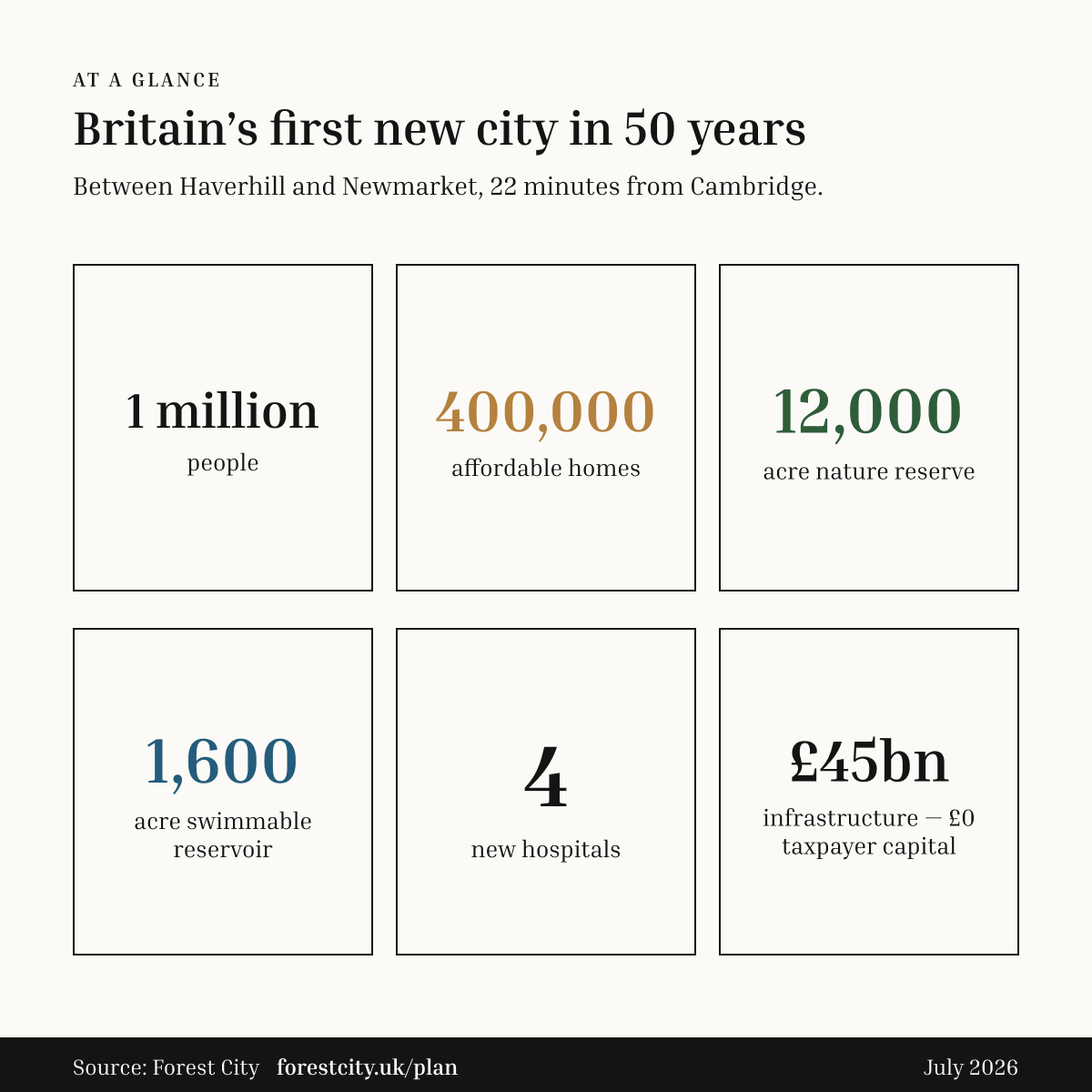
In October 2025, my co-founder, Joe Reeve and I launched Forest City — a proposal for the UK’s first new city in over fifty years. Located on 45,000 acres east of Cambridge, it will house one million people across 400,000 homes, backed by an estimated £43 billion of infrastructure, and surrounded by 12,000 acres of woodland — England’s largest nature reserve on land.
The heart of the project is a simple goal: repair the social contract. What does that mean? Enabling people who work hard to own a home and raise children. Put in more concrete terms, it means returning house prices to the historic norm price-to-earnings ratio of between 3.5 and 5. In the overheated south east — Cambridge, Oxford, London — that ratio sits at around 11. That’s why we’re aiming for a four-bedroom, 1,700 sq ft home at £350,000. 1–3 bed homes, will of course be even more affordable.
So why the need for a whole city? Why can’t you achieve this with a few hundred homes on the edge of a town? To understand why city scale is the only way to get there, you need to understand what actually drives the cost of building homes.
Why the current system is broken by design
The conventional development process starts with a local plan: a call for sites, private developers putting forward proposals, planning authorities weighing in. From the very first step, you’re working within a rigid set of existing assumptions. No one wants to pay for infrastructure. The planning cycle can take five years or more. And because the direction of travel is never truly secret, land prices rise in anticipation — long before a single spade goes in the ground.
It is no surprise, then, that NIMBYs level the same three complaints at nearly every new development: they’re ugly, they have no infrastructure, and when they are built, they are just as expensive as anything else on the market. All three are symptoms of the same structural failure.
To get out of this trap, you have to think about costs from first principles. There are four main cost drivers to building homes at scale: land, planning, build cost, and infrastructure.
The four cost drivers
- Land: Agricultural land: ~£9k/acre. Land with planning: £400k+/acre. Zone 1 London: up to £100m/acre.
- Planning: Long, slow, and unpredictable. Time is money. Risk is expensive. Every delay adds cost.
- Building costs: Greenfield is cheaper than building in existing cities. And at scale, you stop being a market-taker and start making markets and setting your own prices.
- Infrastructure: Rail, roads, schools, hospitals, water, power. In isolation, this is the deal-breaker.
Three problems, one elegant solution
The first three cost drivers have a clear answer. Firstly, try and acquire agricultural land at near enough open market prices — cheap, at around £9,000 an acre. Then, unlock planning speed through a Development Corporation: a fast, assured mechanism with real precedent. The Olympics, Canary Wharf, Milton Keynes were all built that way. The catch is, the government won’t set one up for a modest housing estate; you need something that justifies the deployment of such a powerful instrument. A new city ticks that box.
Then you build at scale. On a greenfield site, with almost no demolition costs, you can take more systemically radical approaches to construction. You also get more efficiency by ensuring a guaranteed pipeline of work. Also major housebuilders we’ve spoken to have told us that a pipeline of 15,000 homes a year would be genuinely transformative for them. At that volume, you stop being a price-taker in the market for materials and labour, and start setting terms and favourable discounts.
So far, so good: agricultural land, a Development Corporation, and building at scale. But this is where you hit the fundamental stumbling block.
The infrastructure problem — and why only city scale solves it
Generally speaking, agricultural land outside of Greenbelts is cheap precisely because there is little infrastructure. No rail. No schools. No hospitals. No power grid to speak of. No one expects development to happen because it can’t without a huge investment.
Our initial estimate puts the infrastructure cost at £43 billion. Trains, roads, schools, hospitals, water, energy, leisure — the full stack. Crudely spread across 400,000 homes, that adds roughly £107,000 to the cost of every single unit. You’ve solved three of the four cost problems but the fourth has put you back to square one.
This is the crucial insight. You can’t build a town and still repair the social contract. You have to build a city. The difference is wrapped up in the value of the commercial land. In a town, you plead with Tesco or a leisure centre operator to open to serve a reasonably small population with amenities. Handing over commercial land at cost is usually the price of getting them in.
But in a city, the population is much higher. Suddenly employers can expect to find the talent and skills they need. They can commit to sourcing their workforce in a place for decades. It’s what economists call the agglomeration threshold: the point at which a concentration of population and talent becomes self-reinforcing, where being there is better than being somewhere else. And other businesses know they’ll make money supplying services to hundreds of thousands of people. They too want to compete for the best sites.
That’s what makes the commercial land — some 8,000 acres in Forest City’s case — for commercial use, genuinely valuable. And that value is what pays for the infrastructure.
Cheap housing as a strategic asset
If Forest City achieves its target of £350,000 for a four-bedroom home, something counterintuitive happens: cheap housing becomes a tool, not just a product.
Cheaper homes sell faster. And faster sales, means borrowing money for less time: financing costs drop across the whole scheme. More than that, highly affordable housing draws in a prospective anchor tenant. Offering the chance for their employees to get on the housing ladder is a massive draw when it is such an impossibility elsewhere.
The logic, once you follow it through, is difficult to escape. If your goal is genuinely affordable housing — not a marginal improvement on the status quo, but a return to what was once considered normal — then the rational conclusion is also the ambitious one: it’s time to build a city.