Cambridge’s Hosepipe Ban Is a Warning — Forest City Is the Answer
This week, Cambridge Water announced its first hosepipe ban in more than 30 years. Anglian Water has followed with restrictions across the East of England. After weeks of sustained heat and limited rainfall, demand has surged 30% while the region’s rare chalk streams and groundwater sources sit under severe pressure.
None of this should surprise anyone. Cambridge is one of the driest regions in the country — semi-arid by some measures — yet for decades we have bolted new housing estates onto Victorian pipes, over-abstracted chalk aquifers, and built almost no new water storage. Cambridge Water doesn’t even own a reservoir. The last major reservoir in this region was completed generations ago. The result is exactly what we’re seeing this week: a growing, prosperous region rationing water in 2026.
The status quo has failed
This is the predictable outcome of how Britain builds. Incremental development — a few hundred homes here, an urban extension there — never carries the scale or funding to deliver new infrastructure. Instead, every new estate draws on the same ancient network, stressing it a little further each time. Water, like roads, rail, and energy, is treated as someone else’s problem, to be patched later. Later never comes.
The choice being presented to local people is false: that we must pick between growth and chalk streams, between new homes and full taps. The real culprit is a model of development that adds demand without ever adding supply.
Forest City: infrastructure first
Forest City takes the opposite approach. We will build a new city east of Cambridge with infrastructure delivered before homes, not after — and that starts with water:
- We will build a new reservoir — major new storage capacity for a region that has built none in living memory. It will supply the new city and strengthen water resilience for existing communities across Cambridgeshire and West Suffolk.
- We will build water-neutral, with rainwater harvesting, water recycling, and modern low-consumption networks designed in from day one — not retrofitted onto century-old pipes.
- We will take pressure off the chalk streams. New storage and lower per-capita consumption mean less abstraction from the aquifers that feed the Cam and its tributaries.
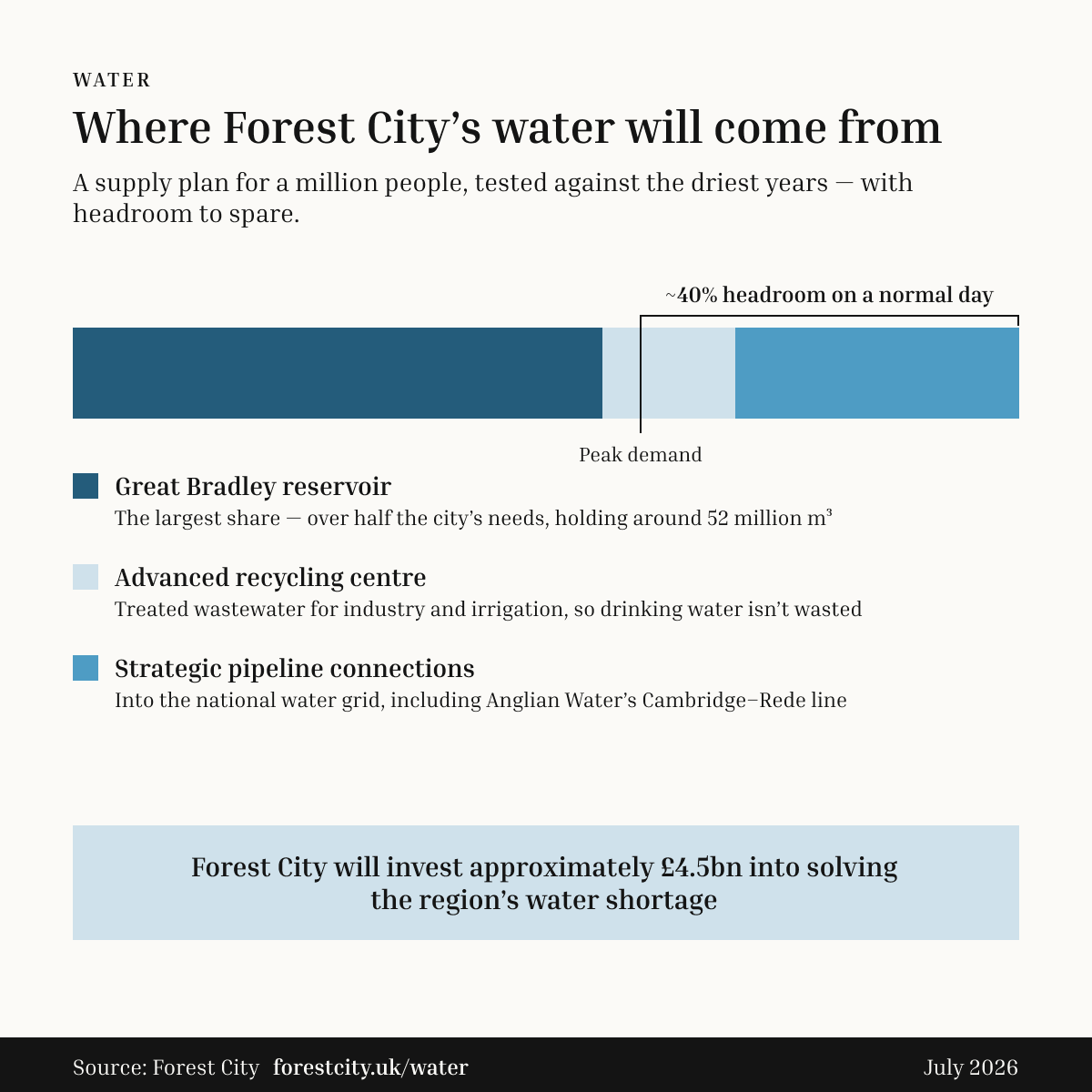
A city built at scale can fund what piecemeal development never can. That is the entire point.
Cambridge’s hosepipe ban isn’t a reason to stop building. It’s the clearest evidence yet that we must build differently. Forest City will build the reservoir, the networks, and the water security this region should have had decades ago — because our generation’s turn to build has arrived.
Learn more about Forest City’s water and infrastructure plans.