366,000 homes are going to be built. The only question is how.
Co-founder of Forest City and former investigative journalist at The Guardian.
What central government’s housing targets actually mean for the area around Forest City — and how they compare with what the region has already built.
How we build homes and infrastructure for the next generation is one of the most contentious issues in local politics. Whilst most everyone agrees we need cheaper power, more water and more affordable homes, few want those developments near them.
Forest City, with its 30 year plan for around 400k fully affordable homes to buy and rent, a new reservoir, rail lines, hospitals, schools and much more has become contentious with locals for just this reason.
Whilst the project has high profile supporters such as the economist Paul Johnson, the founder of the Eden Project, Sir Tim Smit, and the National Federation of Builders, there have naturally been vociferous complaints from regional MPs and councillors from all sides of the party divide.
And yet no one is asking the alternative question; If Forest City doesn’t go ahead, what would happen in the wider area otherwise?
Mandatory targets
Every planning authority in England is handed a mandatory annual housing target by central government, calculated using the standard method set by the Ministry of Housing, Communities and Local Government (MHCLG). Councils can argue about phasing and where individual sites go, but they cannot reject the number itself.
Take the councils within a 30-mile radius of the proposed Forest City site — an area of roughly 1.7 million people that reaches Chelmsford and the edge of Ipswich at one end, and Ely and Downham Market at the other — add their annual targets together, and project them over 30 years — the same period it would take to fully build out Forest City. What is the number of homes that need to be built over that period? The answer is 366,000 homes.
That many homes equates to just under a million more people. Fascinatingly, it is also, give or take, the proposed size of Forest City itself.
Where the number comes from
The “narrow” 30-mile area covers eleven districts across Suffolk, Cambridgeshire and North Essex. Their combined mandatory target is 12,210 homes a year. Over 30 years, that is 366,300 homes.
| District | Annual target |
|---|---|
| Suffolk | |
| East Suffolk | 1,667 |
| Babergh | 775 |
| Mid Suffolk | 734 |
| West Suffolk | 1,200 |
| Cambridgeshire (CPCA) | |
| Greater Cambridge | 2,309 |
| East Cambridgeshire | 600 |
| Fenland | 556 |
| Huntingdonshire | 1,232 |
| North Essex | |
| Uttlesford | 749 |
| Braintree | 1,098 |
| Colchester | 1,290 |
| Total (annual) | 12,210 |
| Total over 30 years (12,210 × 30) | 366,300 |
Targets compiled from each council’s own figures (2026), and consistent with the MHCLG standard method mapped here in 2024 (individual districts have since been revised slightly up or down).
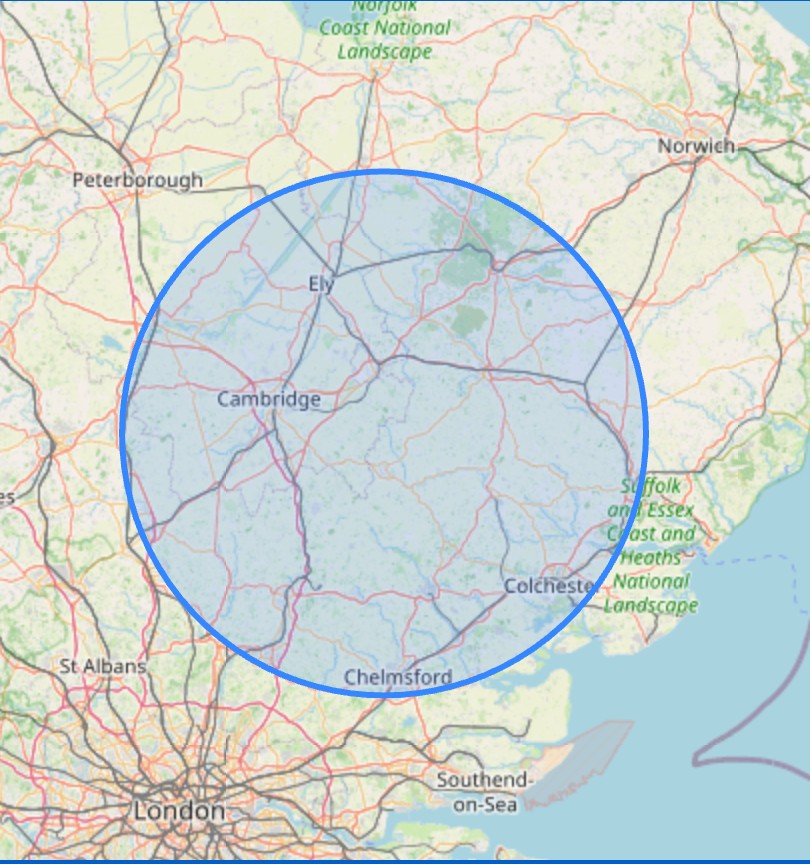
This is deliberately a conservative count. It draws a tight circle and leaves out districts that sit mainly inside it, e.g. Chelmsford. Doing so lifts the projection to roughly 408,000.
What the area has already built
The same exercise, run over the past 30 years, is instructive. According to ONS figures on permanent dwellings completed by tenure and district, the 30 mile area we’re looking at completed 195,000 homes between 1995 and 2025 (this does include Chelmsford).
| Tenure (1995–2025) | Completions | Share |
|---|---|---|
| Private enterprise | 162,150 | 83.2% |
| Housing associations | 32,830 | 16.8% |
| Local authority | 430 | 0.2% |
| All completions | 195,000 | 100% |
Source: ONS, “House building: permanent dwellings started and completed, by tenure and district, 1995–2026”, filtered to the relevant council areas.
Two things stand out. First, this one area did a lot of the region’s building: its 195,000 homes were about a third of all homes built in the entire East of England over those three decades.
Second, councils themselves built almost nothing — 430 homes in 30 years. Delivery was, and remains, overwhelmingly a private-and third sector market activity.
How to build the future
Set against those numbers, the usual local debate — should this particular field be built on? — starts to look like the wrong question. At an area level, the “whether” has largely been decided. The targets exist, they are binding, and they add up to a city’s worth of homes either way. The real question is how and where.
If policy makers and politicians decide to ignore the long term and only battle year-by-year, what will result will be a maintenance of the status quo i.e. the 366,000–408,000 homes arrive the way the last 195,000 did; dispersed across hundreds of sites on the edges of existing towns and villages, largely car-dependent, and usually arriving well before the infrastructure to support it. This is the stuff people absolutely hate.
Look around the region and ask, where is the transport infrastructure? Why hasn’t Cambridge got enough school places? Where is Haverhill’s train station? Why hasn’t Britain’s largest port in Felixstowe got better transport links? Why haven’t we double-tracked Newmarket’s train line? And why oh why is there never any water even after record wet winters? Shouldn’t the development of nearly 200k have supported all this?
Alternative approaches mean thinking beyond the next election and instead actively planning for the next thirty years. Instead of passively accepting random suburban sprawl, putting the homes in one place would create a functioning economic area that would stand on its own two feet. Forest City calculates that a city of a million people would generate £53bn each year, supporting the region around it rather than being a drag on scarce resources, with a total of £45bn in infrastructure spend including hospitals, leisure facilities, police stations, trains, roads, a reservoir and hundreds of new schools.
So the real question is not whether the homes come. They are coming. It is whether concentrating almost the entire allotment in a 30 mile radius in one planned place — with the infrastructure designed in from the start rather than bolted on afterwards and sparing hundreds of villages and nearly 1.7m people in the region three decades of site-by-site conflict — delivers a better outcome for the same number of homes spread out piecemeal like the last twenty years.